The OMSB exam is the Prometric licensing test that the Oman Medical Specialty Board requires before doctors, dentists, nurses, pharmacists, and allied health professionals can practice legally in Oman. Passing it is only part of the process. The step that trips up more applicants than the exam itself is document attestation, a multi-stage chain most other Gulf countries don’t require in the same way. This guide covers OMSB eligibility, the exam itself, and exactly where that attestation step tends to go wrong.
What the OMSB Exam Actually Is, and Who Issues Your License
The Oman Medical Specialty Board (OMSB) runs the exam and professional classification process. Oman’s Ministry of Health then issues the actual license once your classification and exam results are cleared. Two separate bodies handle two separate parts of the same journey, which is why some applicants assume passing the exam alone means they’re licensed. It doesn’t. Your file still needs to clear MOH’s own review afterward.
Table of Contents
Why Oman Is Considered the More Accessible Gulf Option
Compared to the UAE’s three-authority system (DHA, MOH, DOH) and Saudi Arabia’s SCFHS process, Oman’s licensing pathway is generally viewed as more straightforward. The exam itself typically runs 70 to 100 questions, fewer than the roughly 150 questions common across UAE and Saudi exams, and the overall process involves fewer separate registration systems to navigate. This is part of why Oman has become a popular first entry point into the Gulf for professionals building their regional career.
Eligibility by Profession
Doctors: An MBBS, MD, MS, DM, or MCh degree from a recognized university, plus documented post-qualification clinical experience relevant to your intended category (GP, Specialist, or Consultant).
Nurses: A minimum of a three-year nursing diploma or a Bachelor of Science in Nursing (BSN) for Registered Nurse classification. Shorter diploma programs generally don’t meet this threshold, which is worth checking before you invest time in an application.
Dentists, pharmacists, and allied health professionals: A recognized degree in your specific field, with experience requirements that scale by title, similar to the pattern used across other Gulf authorities.
The Attestation Chain Nobody Warns You About
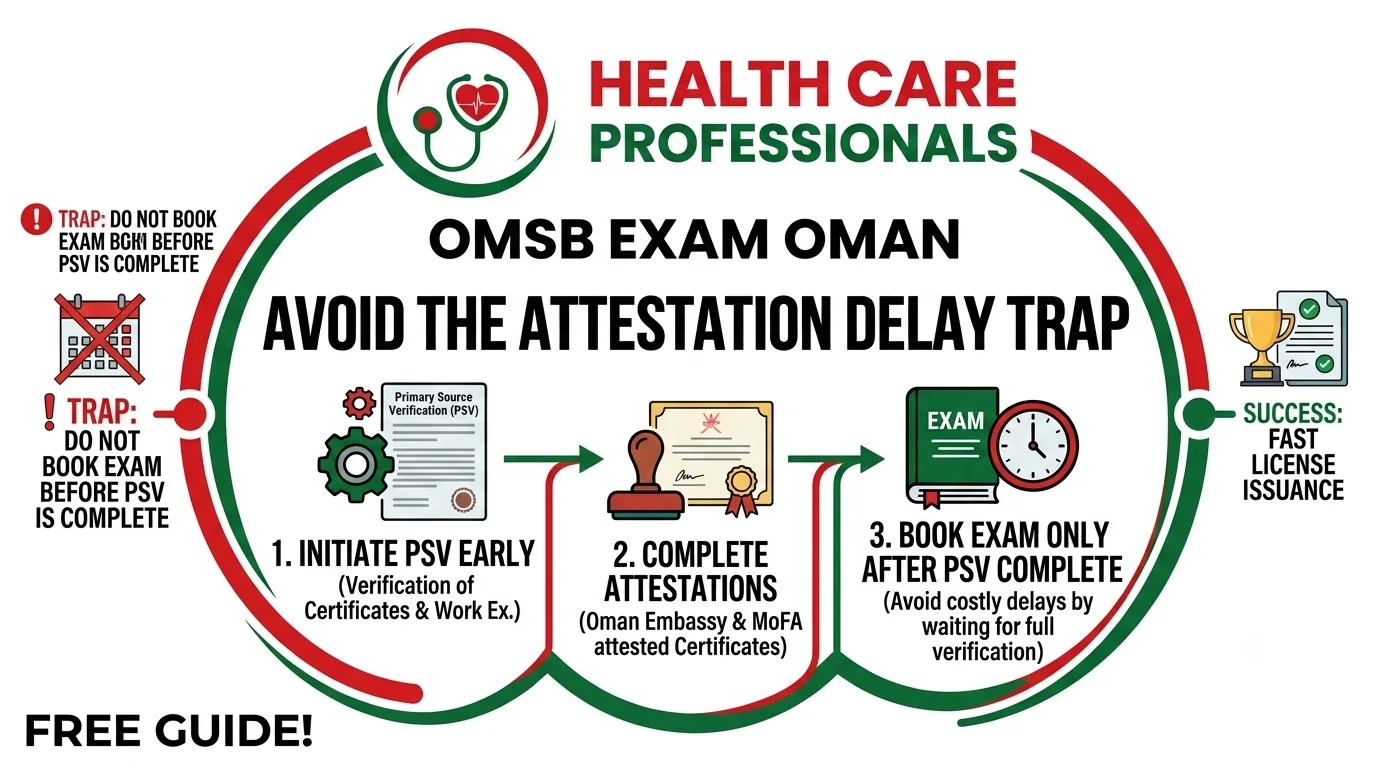
This is the detail that separates Oman’s process from most of its neighbors, and it’s the single most common cause of delay. Your academic certificates and professional documents generally need to pass through a multi-step attestation chain: notarization in your home country, attestation by your home country’s Ministry of Foreign Affairs, attestation by the Oman Embassy in your home country, and finally attestation by Oman’s own Ministry of Foreign Affairs.
Miss a step, get the order wrong, or submit a document that was attested before an underlying certificate was updated, and the whole chain can bounce back to the beginning. Start this process early, and treat it as its own project running alongside your DataFlow verification rather than something to handle after your exam is booked.
Step-by-Step: How OMSB Licensing Actually Works
1. Confirm your eligibility against OMSB’s Professional Qualification Requirements. Requirements vary by profession and title, so check your specific category before applying.
2. Complete DataFlow Primary Source Verification. As with every Gulf authority, your degree, license, and experience get verified directly with the issuing institutions. See our OMSB DataFlow guide for the full breakdown.
3. Begin document attestation in parallel. Don’t wait for DataFlow to finish before starting this chain, since it typically takes just as long, if not longer.
4. Receive your OMSB eligibility ID. Once your file is approved, you can book your Prometric exam.
5. Book and sit your Prometric exam. Available at authorized centers worldwide, including major cities across India, the Philippines, and the UAE.
6. Submit your attested documents and exam result to OMSB and MOH. This is where your classification and, ultimately, your license get finalized.
Documents You’ll Typically Need
- Passport copy and passport-size photograph
- Degree or diploma certificate with full transcript
- A current Good Standing Certificate from your home country’s medical or nursing council, generally issued within the past three to six months
- Experience certificates matching your intended classification
- Fully attested copies of your academic and professional documents
Exam Format
The OMSB Prometric exam generally runs 70 to 100 multiple-choice questions, testing clinical knowledge, reasoning, and practical understanding specific to your category. Doctors are tested across core clinical domains including general medicine, surgery, pediatrics, obstetrics and gynecology, and their own specialty where applicable.
Fees and Realistic Timeline
Budget for separate charges at each stage: DataFlow verification (scaling with document count), the Prometric exam fee itself, and attestation fees at each stage of the document chain, which add up faster than most applicants expect. DataFlow verification and document attestation are typically the two longest stages, both commonly running several weeks to a couple of months when done in parallel. Confirm current fees directly through the OMSB official portal before budgeting.
Common Mistakes That Delay OMSB Applications
- Starting attestation late. Treating it as a final step rather than a parallel one is the single biggest cause of delay.
- Assuming a shorter nursing diploma qualifies. OMSB generally requires a three-year diploma or BSN for Registered Nurse classification.
- Assuming passing the exam means you’re licensed. OMSB handles the exam and classification; Oman’s Ministry of Health issues the final license.
- Letting your Good Standing Certificate expire mid-process. It’s typically only valid for three to six months from issue.
- Submitting documents out of attestation order. Each stage generally depends on the one before it being completed correctly first.
Frequently Asked Questions
Who actually issues my license after the OMSB exam?
Oman’s Ministry of Health issues the final license. OMSB handles the exam and professional classification, but the two are separate steps.
How many questions are on the OMSB exam?
Generally 70 to 100 multiple-choice questions, fewer than the roughly 150 common across UAE and Saudi licensing exams.
Why does document attestation take so long for Oman?
Because it typically requires four separate stages: home country notarization, home Ministry of Foreign Affairs, the Oman Embassy, and Oman’s own Ministry of Foreign Affairs. Missing or misordering any step can send documents back to the start.
Can nurses with a two-year diploma apply for OMSB licensing?
Generally no. OMSB typically requires a minimum three-year nursing diploma or a BSN for Registered Nurse classification.
Is Oman’s licensing process really easier than the UAE or Saudi Arabia?
Generally yes, with fewer exam questions and fewer separate registration systems, though the attestation requirement adds its own complexity that those countries don’t require in the same form.
About the Author
This guide was written by the team at Rahat Health Care Professionals Consultancy & Training Center, led by founder Rahat Zaman, a medical licensing consultant since 2018 with hands-on experience guiding healthcare professionals through DHA, MOH, DOH, and wider Gulf licensing processes. Our team has supported over 21000 healthcare professionals through DataFlow verification, exam registration, and license activation across the UAE and internationally.
Last updated: July 2026
Follow us on social media to stay updated!