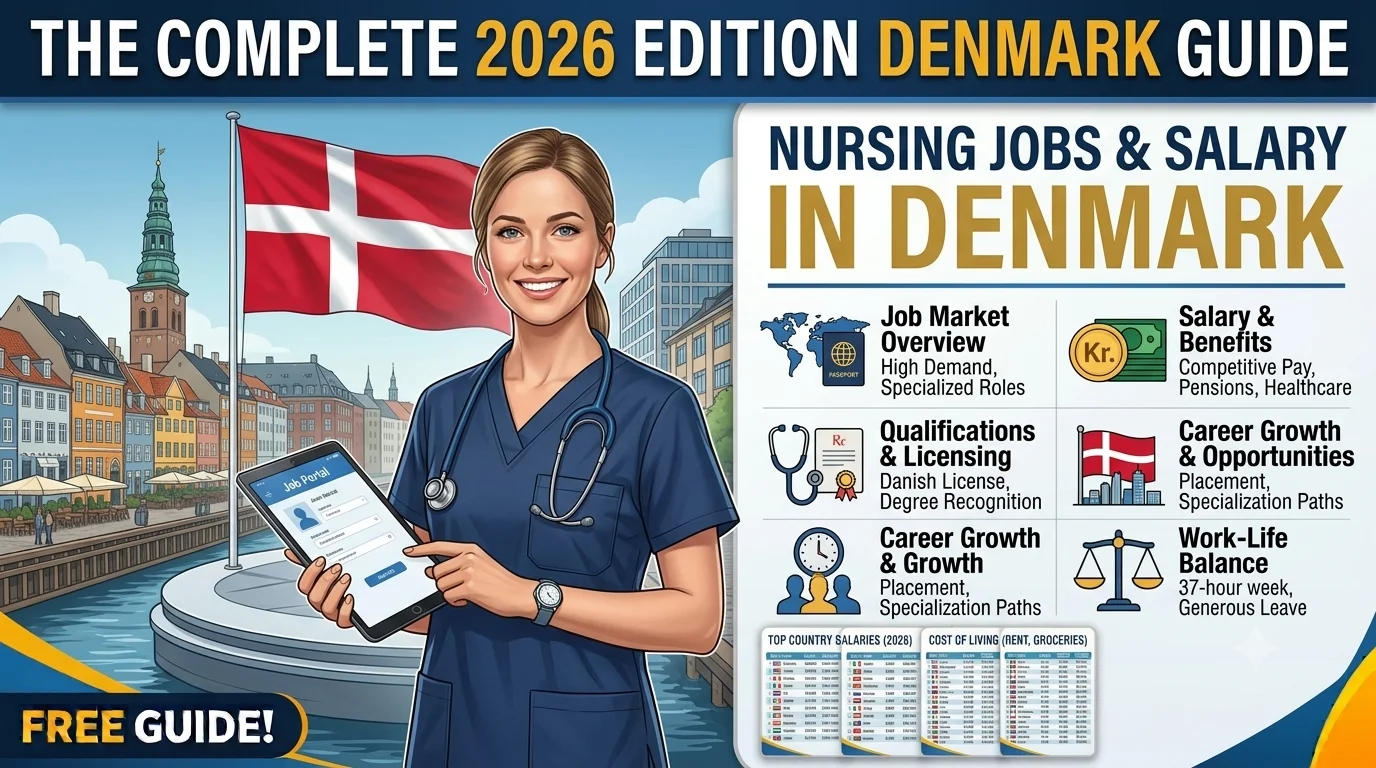
Nursing jobs and salary in Denmark are genuinely strong: base pay of DKK 30,000 to 42,000 or more a month, a well-funded public system, and one of the world’s most respected healthcare workforces. But there’s a fact almost every article on this topic leaves out, and it changes everything for most people reading this. Since 7 October 2025, Denmark has set the authorization quota for nurses from outside the EU/EEA to zero, and that quota stays in place until 31 December 2026. If you’re not an EU/EEA national and didn’t already have legal residence in Denmark before that date, you currently cannot get authorized to work as a nurse there, no matter how strong your qualifications are.
This guide covers what that quota actually means, who’s still exempt, what the salary and job market genuinely look like, and what your realistic options are right now.
What the Zero Quota Actually Means
Denmark’s Patient Safety Authority (Styrelsen for Patientsikkerhed) introduced this quota because, in its own words, there’s currently no general shortage of nurses in Denmark. The quota applies specifically to nurses who are citizens of, or educated in, countries outside the EU/EEA. While it’s in effect, applications for a residence permit tied to nurse authorization are refused, and this includes applications that were already pending before the quota started.
If you submitted an application before 7 October 2025 and it was still pending on that date, it gets rejected and closed, even if your education had already been formally approved by the Authority. That last part catches people off guard the most: approval of your credentials doesn’t protect you from the quota once it applies to your case.
Table of Contents
Who Is Still Exempt and Can Apply Right Now
The quota doesn’t block everyone. You can still apply for Danish nurse authorization if any of the following applies to you:
- You’re a Danish national, including from the Faroe Islands or Greenland
- You’re a national of another EU/EEA country, even if you were educated outside the EU/EEA
- You completed your nursing education in Greenland or the Faroe Islands
- You already have valid legal residence in Denmark at the time of application
- You have a specific job offer for adaptation and training purposes as a “specifically requested healthcare professional,” and that offer covers the entire three-year evaluation period the Authority requires
That last exemption is narrow and requires a real, specific employer commitment, not a general job search. If none of these apply to you, applying right now means an almost certain rejection, regardless of how strong your nursing degree or experience is.
What Happens After 31 December 2026?
Nobody can say for certain yet. The quota is officially set to run through that date, and whether it’s extended, adjusted, or lifted depends on Denmark’s nursing workforce situation closer to that time. If you’re planning toward Denmark as a longer-term goal, the most reliable move is checking the Danish Patient Safety Authority’s own quota page directly and periodically, rather than relying on any article, including this one, for the latest status once you’re closer to that date.
Nurse Salary in Denmark: The Real Numbers
For EU/EEA nurses who can currently apply, or for anyone planning ahead for after the quota changes, here’s what pay actually looks like. Base salary for a registered nurse (sygeplejerske) in Denmark generally runs DKK 30,000 to 42,000 or more a month, with most nurses landing in the DKK 400,000 to 500,000 annual range once tillæg (shift and role premiums) are included.
Shift premiums add real money on top of base pay. A nurse working a typical rotation of roughly 50% day shifts, 25% evening shifts, and 25% weekend shifts can expect an additional DKK 4,000 to 6,000 a month from shift tillæg alone, and night-shift nurses often see more. Specialized roles, such as wound care specialists or infection control nurses, can add a further DKK 1,000 to 3,000 a month through funktionstillæg.
Denmark also has one of the strongest nursing unions in Europe. The Dansk Sygeplejeråd (DSR) represents roughly 80,000 nurses, negotiates the collective agreements that set these pay scales in the first place, and offers legal and career support for a membership fee around DKK 900 a month, which is tax-deductible.
Cost of Living in Denmark
Denmark is genuinely expensive, and Copenhagen in particular runs meaningfully above the national average for rent and everyday costs. Danish income tax is also relatively high compared to many other nursing destinations. That said, Denmark’s strong pension contributions, generous leave policies, and well-funded public services mean the actual quality of life a Danish nursing salary buys tends to be high, even after accounting for tax and cost of living, for those who are able to work there.
The Standard Authorization Process, for Those Who Can Currently Apply
For EU/EEA nurses and anyone else exempt from the quota, the path to Danish authorization looks like this: submit your educational certificates, proof of work experience, and any additional training documentation to the Danish Patient Safety Authority, with EU/EEA-issued documents generally receiving faster, more streamlined recognition under the EU’s mutual qualification recognition rules than non-EU credentials.
A few details worth knowing regardless of your exemption category. Danish language proficiency at B2 level or above is generally expected, since patient documentation and clinical communication run in Danish. There’s also a six-year rule: if you completed your nursing education more than six years before the Authority receives your fully documented application, your application is rejected unless you can prove at least twelve months of full-time nursing experience within the six years immediately before applying.
Documents Generally Required
- Nursing diplomas and academic transcripts
- Proof of professional experience
- Certificates showing Danish language proficiency (B2 or above)
- Passport or other government-issued identification
- A health certificate confirming fitness to practice
If You’re Currently Blocked, What Are Your Realistic Options?
If the quota rules you out for now, it’s worth widening your search rather than waiting on a policy that may or may not change by the end of 2026. Countries across the Gulf, including Saudi Arabia, Qatar, and the UAE, currently run well-documented, active licensing pathways for internationally educated nurses, with strong tax-free salaries and genuine demand driving continued hiring. Our complete nursing salary comparison by country breaks down how these alternatives actually compare on pay, cost of living, and how quickly you can realistically get licensed, which is worth reading before you commit your time and savings to a market that’s currently closed to most non-EU applicants.
Frequently Asked Questions
Can I still apply for a nursing job in Denmark right now?
Only if you’re an EU/EEA national, a Danish citizen, already have legal residence in Denmark, were educated in Greenland or the Faroe Islands, or have a specific adaptation and training job offer covering the full three-year evaluation period. Everyone else is currently blocked by the zero quota in effect until 31 December 2026.
Why did Denmark introduce a zero quota for nurses?
The Danish Patient Safety Authority states there’s currently no general shortage of nurses in Denmark, which is the stated reason for pausing non-EU/EEA authorization applications.
What happens to my application if I applied before the quota started?
If your application was still pending on 7 October 2025, it gets rejected and closed, even if your educational qualifications had already been approved.
What is the average nurse salary in Denmark?
Most nurses earn between DKK 400,000 and 500,000 a year including shift premiums, working out to a base of roughly DKK 30,000 to 42,000 a month before tillæg.
Will the Denmark nursing quota be lifted after 2026?
It’s not confirmed either way. The quota currently runs through 31 December 2026, and whether it’s extended or lifted depends on Denmark’s workforce needs closer to that date.
What should I do if I’m currently blocked from applying to Denmark?
Consider active, currently open pathways such as the Gulf countries, which maintain well-documented licensing processes and strong ongoing demand for internationally educated nurses.
About the Author
This guide was written by the team at Rahat Health Care Professionals Consultancy & Training Center, led by founder Rahat Zaman, a medical licensing consultant since 2018 with hands-on experience guiding healthcare professionals through DHA, MOH, DOH, and wider Gulf licensing processes. Our team has supported over 21000 healthcare professionals through DataFlow verification, exam registration, and license activation across the UAE and internationally.
Last updated: July 2026
Follow us on social media to stay updated!