The Competence Assessment Programme is the supervised clinical placement that internationally educated nurses in Ireland complete when the Nursing and Midwifery Board of Ireland (NMBI) requires a compensation measure before granting full registration. Most guides walk you through the paperwork and the six domains of competence. Almost none of them mention the actual obstacle that delays most applicants for months: finding a hospital that’s actually approved to run one.
Quick Facts
- Regulator: Nursing and Midwifery Board of Ireland (NMBI)
- Also known as: the Adaptation Programme, or Adaptation and Assessment Programme
- Typical duration: 6 to 12 weeks of supervised clinical placement
- Alternative pathway: the RCSI Aptitude Test, a 2-day exam instead of a placement
- Approved hospitals: roughly 35, out of more than 86 hospitals across Ireland
- Realistic total NMBI registration timeline: 12 to 18 months from first application to full registration
Table of Contents
What the Competence Assessment Programme Actually Involves
If your NMBI Decision Letter requires a compensation measure, meaning your qualification doesn’t automatically meet Irish registration standards, you generally have two options: complete the Adaptation Programme, a supervised clinical placement, or sit the RCSI Aptitude Test instead. During adaptation, you work under the scope of an undergraduate intern at an NMBI-approved hospital, supervised by a Preceptor who assesses you against six domains of competence covering professional values, clinical decision-making, and related standards. At the end, your Director of Nursing submits a report and Candidate Eligibility Report to NMBI, which then determines your registration outcome.
The Real Bottleneck Nobody Warns You About
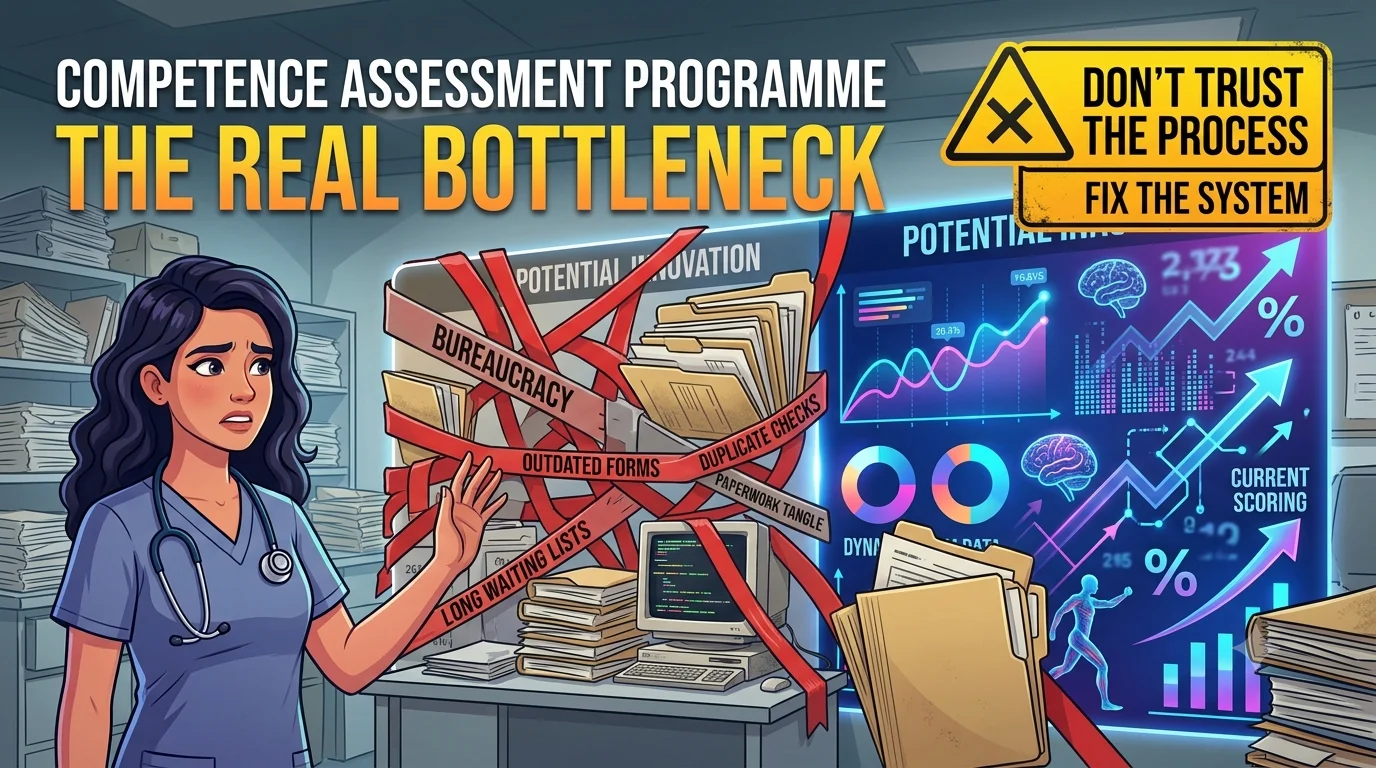
This is the part that catches applicants off guard far more than the assessment itself. Only around 35 hospitals in Ireland are currently NMBI-approved to run adaptation placements, out of more than 86 hospitals nationwide, less than half. Most of the approved facilities sit within the public system, where the recruitment process alone commonly takes four to five months before your placement even begins, on top of whatever time it took to reach this stage of your NMBI journey in the first place.
In practical terms, this means passing your qualification review and receiving a Decision Letter isn’t the finish line, or even close to it. Securing an actual placement at one of the limited approved hospitals is frequently the longest single stretch of the entire process, and it’s the stage most articles about NMBI registration barely mention.
How the Adaptation Placement Actually Runs
A typical adaptation placement follows a fairly structured rhythm. In week one, you and the programme team establish a learning plan based on a self-assessment of your existing skills. A mid-placement review around weeks two to three checks your progress. The remaining weeks continue supervised, increasingly independent practice, with a final assessment meeting in the last week, requiring a minimum 80 percent attendance record throughout. If your Preceptor marks you competent across all required domains, your Director of Nursing submits the Candidate Eligibility Report to NMBI, and you can then move toward full registration and employment as a Registered Nurse with that same hospital.
Adaptation placements are typically paid, but generally at a lower, student or assistant nurse rate rather than a full Registered Nurse salary, which is worth factoring into your budget if you’re relocating specifically for this stage.
The RCSI Aptitude Test: The Alternative Worth Considering
If securing an approved hospital placement looks like it’s going to be the bottleneck for you, the RCSI (Royal College of Surgeons in Ireland) Aptitude Test is worth serious consideration instead. It’s a two-day exam in Dublin: a theoretical component with 150 multiple-choice questions completed in three hours, requiring a minimum 50 percent to pass, followed by a practical OSCE (Objective Structured Clinical Examination) component. Results are typically available within a few days.
The clear advantage is that it sidesteps the hospital placement bottleneck entirely. The tradeoff is that it’s a concentrated, high-pressure assessment rather than a gradual, supervised placement, which suits some candidates better than others depending on how they perform under exam conditions versus real clinical supervision over several weeks.
How You End Up Needing a Compensation Measure in the First Place
This stage only applies after NMBI has already reviewed your qualifications and issued a Decision Letter. Before reaching this point, you’ll have gone through NMBI’s Qualification Recognition process, submitted your documents through the MyNMBI portal, and met English language requirements, generally IELTS 7.0 or an equivalent OET Grade B. Only if your qualification doesn’t meet Irish standards outright does NMBI direct you toward the Adaptation Programme or Aptitude Test as a compensation measure rather than approving you for direct registration.
Realistic Total Timeline
Accounting for qualification recognition, document verification, the compensation measure itself, and securing an actual placement or exam date, most internationally educated nurses should realistically plan for 12 to 18 months from starting the NMBI process to holding full registration. This is considerably longer than licensing processes in many other countries, which is worth weighing seriously if your timeline for relocating is tighter than that.
Common Mistakes
- Assuming the Decision Letter is the hard part. For most applicants, securing an NMBI-approved placement is the longer and less predictable stage.
- Only applying to public hospitals. With roughly 35 approved facilities nationwide and lengthy public-sector recruitment timelines, it’s worth researching every approved hospital, not just the largest public ones.
- Not budgeting for the lower adaptation-period pay rate. Placements are typically paid at a student or assistant nurse rate, not full RN salary.
- Dismissing the Aptitude Test without comparing it properly. For candidates confident under exam conditions, it can be considerably faster than waiting on a placement.
- Underestimating the full timeline. Twelve to eighteen months is the realistic range for most applicants requiring a compensation measure, not the six to twelve weeks the adaptation placement itself takes.
If Your Timeline Doesn’t Allow for This
If a 12 to 18 month process doesn’t fit your circumstances, it’s worth knowing that other regions maintain considerably faster, well-documented licensing pathways for internationally educated nurses. Our complete nursing salary comparison by country breaks down how the Gulf’s DataFlow-based licensing systems, which typically run a few months rather than over a year, compare on pay, cost of living, and realistic timelines.
Frequently Asked Questions
What is the Competence Assessment Programme? It’s the supervised clinical placement, also called the Adaptation Programme, that internationally educated nurses in Ireland complete when NMBI requires a compensation measure before granting full registration, typically lasting 6 to 12 weeks.
Why is finding a placement so difficult? Only around 35 hospitals in Ireland are NMBI-approved to run adaptation placements, out of more than 86 hospitals nationwide, and most sit within the public system, where recruitment alone can take four to five months.
Is the RCSI Aptitude Test easier than the Adaptation Programme? Not necessarily easier, but different. It’s a concentrated two-day exam (150 MCQs plus an OSCE) rather than a multi-week supervised placement, and it avoids the hospital placement bottleneck entirely.
How long does the whole NMBI registration process take? Most internationally educated nurses requiring a compensation measure should realistically plan for 12 to 18 months from starting the process to full registration.
Are adaptation placements paid? Generally yes, but typically at a student or assistant nurse rate rather than a full Registered Nurse salary.
About the Author
This guide was written by the team at Rahat Health Care Professionals Consultancy & Training Center, led by founder Rahat Zaman, a medical licensing consultant since 2018 with hands-on experience guiding healthcare professionals through DHA, MOH, DOH, and wider Gulf licensing processes. Our team has supported over 21000 healthcare professionals through DataFlow verification, exam registration, and license activation across the UAE and internationally.
Last updated: September 2026
Follow us on social media to stay updated!