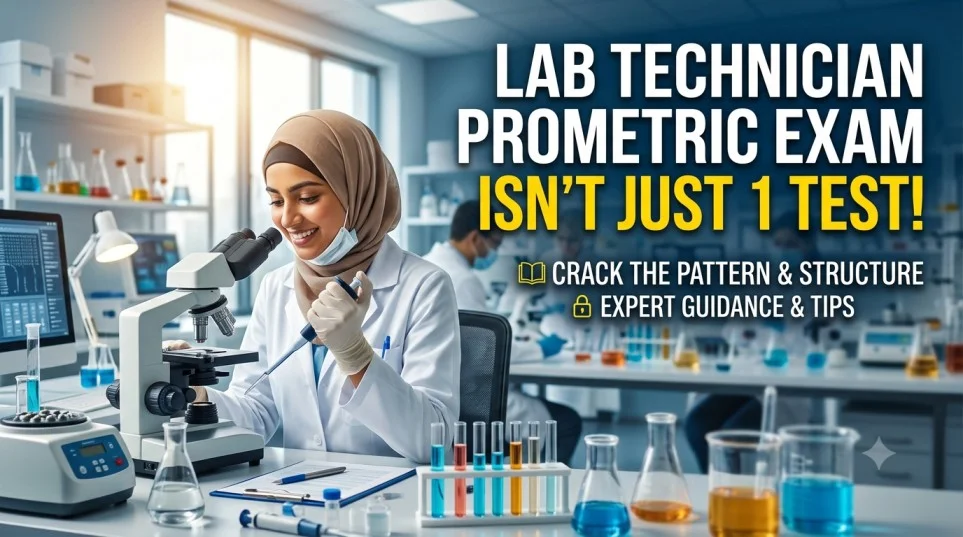
Search “lab technician Prometric exam” and most results treat it like a single, universal test with one syllabus and one pass mark. It isn’t. A DHA lab technician exam, a Saudi SCFHS exam, and an Omani OMSB exam all cover overlapping ground, but the exact code, question count, pass mark, and fee attached to each one are genuinely different. Treating them as interchangeable is exactly how candidates show up under-prepared for the one that actually applies to them.
This guide breaks down what the lab technician Prometric exam actually involves, country by country, along with the syllabus, eligibility, and fees you need to know before you book.
What Is the Lab Technician Prometric Exam?
It’s the licensing exam that medical laboratory technicians and technologists must pass before they can legally work in a Gulf healthcare facility. Most Gulf authorities, including DHA, MOH, SCFHS, and QCHP, deliver this exam through Prometric. DOH in Abu Dhabi is the one notable exception, using Pearson VUE instead, and Oman runs its own distinctly named exam rather than a generic “lab technician Prometric exam.”
Passing gets you an eligibility letter, not an automatic license. You’ll still need a confirmed job offer and a completed DataFlow verification before you can actually start practicing.
Table of Contents
Who Needs to Take It?
Anyone applying to work as a medical laboratory technician or technologist in a Gulf healthcare facility, typically holding a diploma or bachelor’s degree in Medical Laboratory Technology (MLT) or Medical Laboratory Science. Most authorities also expect a minimum period of relevant clinical laboratory experience, commonly cited around three years, along with a valid registration or license from your home country.
The DHA Lab Technician Exam: Code, Format, and Pass Mark
DHA assigns lab technician licensing its own specific exam code, LAB5601, something a surprising number of prep guides never actually mention. The exam runs 150 multiple-choice questions over three hours, and the minimum pass score is 45%, on the lower end compared to some clinical professions, though still requiring solid coverage across the full syllabus rather than a narrow specialty focus.
The Prometric exam fee for DHA lab technicians is commonly cited around USD 240. To be eligible, you’ll typically need a diploma or bachelor’s degree in Medical Laboratory Technology, experience matching DHA’s Professional Qualification Requirements (PQR) for your title, a valid home-country license or registration, and a completed DataFlow submission before you can book your exam slot.
MOH and SCFHS: Similar Format, Different Numbers
MOH’s lab technician exam, delivered through the Sharjah/MOHAP Prometric system, follows a broadly similar structure to DHA’s, generally 100 to 150 questions over two and a half to three and a half hours, though the exact count and timing depend on your specific title and category. SCFHS runs its own version through the Saudi Prometric system, tied into the Mumaris Plus platform, with eligibility and pass mark requirements confirmed at the point of registration rather than published as one fixed universal figure.
Across both authorities, the underlying subject matter overlaps heavily with DHA’s syllabus, but the exact pass mark and fee for your specific title should always be confirmed directly through that authority’s own registration portal rather than assumed to match DHA’s numbers exactly.
QCHP and the Rest of the Region
Qatar’s QCHP (now operating under the Department of Healthcare Professions) also delivers its lab technician exam through Prometric, again with a broadly comparable syllabus and format to the other UAE and Saudi versions. Bahrain’s NHRA and Kuwait’s MOH run their own versions as well, each with country-specific eligibility and fee details worth confirming directly before you register.
Oman Is the Outlier: OEMLS, Not a Generic Prometric Exam
This is one of the most commonly missed details across lab technician exam guides. Since January 2023, Oman doesn’t run lab technicians through a generic Prometric exam at all. OMSB introduced a dedicated exam called the Omani Examination for Medical Laboratory Scientists (OEMLS), covering both local Omani graduates and internationally trained candidates. Eligibility requires a bachelor’s degree in Medical Laboratory Science from a recognized institution, and the exam is built specifically around scientific investigation, sample analysis, and interpretation of test results rather than being a rebadged version of the DHA or SCFHS syllabus.
If you’re preparing for Oman specifically, studying generic Gulf lab technician material without accounting for OEMLS’s distinct structure is a real gap.
What the Syllabus Actually Covers
Regardless of which authority you’re sitting the exam for, the core subject areas stay fairly consistent:
Clinical Biochemistry, Hematology, Microbiology, Immunology and Serology, Blood Banking and Transfusion Medicine, Laboratory Safety, Quality Control and Quality Assurance, and Professional Ethics. DHA’s specific breakdown expands this into roughly eleven distinct topic areas, giving slightly more granular weight to diagnostic testing and biosafety alongside the core science subjects.
Preparing around this full spread matters more than cramming any single subject, since questions are generally scenario-based rather than pure recall, asking you to apply lab science knowledge to a realistic diagnostic or safety situation rather than just naming a test.
Documents You’ll Typically Need
Most applicants across every Gulf authority prepare a similar core document set: passport copy and passport-size photo, your MLT diploma or degree certificate with transcript, your professional license or registration certificate, experience letters covering the required window, a Good Standing Certificate valid for six months, and DataFlow’s completed Primary Source Verification report confirming all of the above directly with the issuing institutions.
Comparison at a Glance
| Authority | Exam Vendor | Typical Format | Pass Mark |
|---|---|---|---|
| DHA | Prometric | 150 MCQs, 3 hours (code LAB5601) | 45% |
| MOH (MOHAP) | Prometric | 100–150 MCQs, 2.5–3.5 hours | Confirm at registration |
| DOH | Pearson VUE | ~150 MCQs, similar length | Confirm at registration |
| SCFHS | Prometric via Mumaris Plus | Varies by title | Confirm at registration |
| QCHP (DHP) | Prometric | Similar format to DHA | Confirm at registration |
| OMSB | OEMLS (dedicated exam) | Structured around lab science competencies | Confirm at registration |
Treat the pass mark column as a starting reference. DHA is one of the few authorities that publishes a clear, consistent figure; most others confirm the exact threshold for your specific title only once your registration is active.
Common Mistakes Candidates Make
A lot of failed first attempts come down to avoidable planning issues rather than genuine knowledge gaps. Studying generic “Gulf lab technician” material without checking which specific authority and exam code applies to you is one of the most common. Assuming Oman follows the same Prometric structure as the UAE, when it actually runs the separate OEMLS exam, is another. And booking an exam slot before DataFlow verification has cleared is a mistake that shows up across every profession, not just lab technicians, and one that can cost you a non-refundable exam fee if a discrepancy surfaces afterward.
How Long Does the Whole Process Take?
Realistically, from your first DataFlow submission to holding a usable eligibility letter, most lab technician applicants are looking at somewhere between two and three months. DataFlow’s Primary Source Verification is the largest single chunk of that timeline, typically running 30 to 45 working days on its own, depending on how quickly your university and past employers respond once contacted. Authority-side credentialing review generally adds another one to four weeks on top of that, and then there’s the exam booking and results window itself, usually a matter of days rather than weeks once your slot is confirmed.
Preparing for the Exam
Because the syllabus leans heavily on scenario-based questions rather than pure recall, the most effective preparation usually combines standard laboratory science references with practice questions that mirror the exam’s clinical-scenario style. Reviewing quality control and laboratory safety protocols tends to pay off disproportionately, since these areas show up across almost every Gulf lab technician exam regardless of authority, even when the rest of the syllabus weighting shifts slightly.
It’s also worth reviewing your specific authority’s PQR or equivalent qualification standard before you study, since it tells you exactly which experience and education combination they expect for your title, which can shape how deep you need to go into certain subject areas versus others.
What Happens After You Pass
Passing the exam gets you an eligibility letter, not an automatic license. From there, you’ll need a confirmed job offer from a licensed facility, which you submit to the relevant authority’s portal to activate your actual practicing license. Most eligibility letters carry a limited validity window, commonly around six months to a year depending on the authority, so it’s worth pursuing job applications fairly soon after passing rather than letting that window run down before you’ve secured a position.
Renewing Your License and Ongoing Requirements
Once licensed, most authorities expect lab technicians to meet ongoing continuing education or professional development requirements to keep the license active at renewal time. Requirements vary by authority and aren’t always published as one fixed universal number, so it’s worth confirming your specific renewal obligations directly with whichever authority issued your license rather than assuming they match another country’s rules.
A Few Terms Worth Knowing
MLT stands for Medical Laboratory Technology, the degree or diploma field most lab technician applicants hold. PQR (Professional Qualification Requirements) is the reference standard several Gulf authorities use to set the minimum education and experience bar for each title. OEMLS is Oman’s dedicated lab technician licensing exam, distinct from the generic Prometric format used elsewhere in the region. Eligibility letter is the document issued once you pass, confirming you can begin applying for jobs, though it isn’t the license itself and typically carries its own expiry window.
Frequently Asked Questions
What is the DHA exam code for lab technicians? LAB5601. This is DHA’s specific code for medical laboratory technician and technologist licensing.
How many questions are on the DHA lab technician exam? 150 multiple-choice questions, to be completed within three hours.
What is the passing score for the DHA lab technician exam? The minimum pass mark is 45%.
How much does the DHA lab technician exam cost? The Prometric exam fee is commonly cited around USD 240, though it’s worth confirming the current amount directly through Prometric at booking.
Does Oman use the same Prometric exam as the UAE for lab technicians? No. Since January 2023, Oman uses a dedicated exam called OEMLS (Omani Examination for Medical Laboratory Scientists), which is structured differently from the generic Gulf Prometric format.
Do I need DataFlow verification before I can book the exam? Yes, across every Gulf authority. DataFlow’s Primary Source Verification needs to clear before your exam eligibility is confirmed.
Why the Confusion Between Authorities Happens So Often
A big part of why lab technicians run into trouble here is that most third-party prep material markets itself generically, a single MCQ bank sold as covering “DHA, MOH, SCFHS, and OMSB” all at once, without flagging that the underlying exams genuinely differ in code, format, pass mark, and in Oman’s case, entire exam identity. That’s not necessarily bad material, the core science overlaps enough that general practice questions still have value, but it’s worth pairing any generic study resource with the specific eligibility page and exam blueprint published by your actual target authority, rather than assuming one MCQ set fully prepares you for every country at once.
Choosing Which Authority to Apply to First
If you haven’t committed to a specific country yet, a few practical factors are worth weighing beyond salary alone. DHA publishes some of the clearest, most specific exam details of any Gulf authority, including its exact code and pass mark, which can make preparation more straightforward if you’re applying somewhat blind without a specific job offer yet. Saudi Arabia’s SCFHS system, tied to Vision 2030’s healthcare expansion, tends to have a larger volume of open lab technician roles overall. Oman’s separate OEMLS pathway is worth factoring in early if that’s a serious option, since it means a genuinely different preparation track rather than a shared one with the rest of the region.
Getting Help With Your Application
If you’d rather have someone confirm which authority’s exam applies to your specific situation, manage your DataFlow verification, and guide your Prometric booking, our team can walk you through it. Reach out at info@healthcareprofessionals.ae or call +971-566-185-270.
About the Author
This guide was written by the team at Rahat Health Care Professionals Consultancy & Training Center, led by founder Rahat Zaman, a medical licensing consultant since 2018 with hands-on experience guiding healthcare professionals through DHA, MOH, DOH, and wider Gulf licensing processes. Our team has supported over 21000 healthcare professionals through DataFlow verification, exam registration, and license activation across the UAE and internationally.
Last updated: September 2026
Follow us on social media to stay updated!