
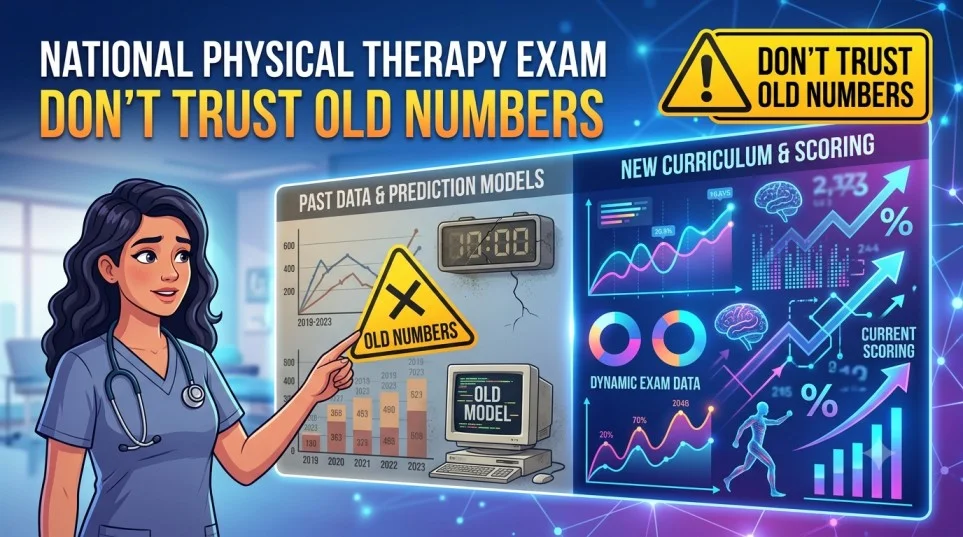
The National Physical Therapy Exam changed its format in January 2024, and a surprising number of study guides, forum posts, and prep articles still haven’t caught up. Search around and you’ll find plenty of pages confidently listing 250 total questions and 200 scored items. That’s the old format. If you’re studying from a source still quoting those numbers, you’re preparing around a version of the exam that no longer exists.
This guide covers the National Physical Therapy Exam as it actually runs today: the current question count, scoring system, eligibility rules, fees, and retake policy, along with the two format additions from the 2024 update that catch a lot of first-time candidates off guard.
What Is the National Physical Therapy Exam?
The National Physical Therapy Exam, commonly called the NPTE, is the licensure exam administered by the Federation of State Boards of Physical Therapy (FSBPT). Every state and U.S. territory requires a passing NPTE score before issuing a physical therapist or physical therapist assistant license, which makes it one of the few genuinely universal requirements across the entire profession in the United States.
The exam is computer-based, delivered at Prometric testing centers, and designed to measure whether a candidate can apply clinical reasoning safely as an entry-level practitioner, not simply recall facts from a textbook.
Table of Contents
The Current Format: 225 Questions, Not 250
As of the January 2024 update, the NPTE-PT contains 225 total multiple-choice questions, not 250. Of those, 180 are scored and count toward your result, while 45 are unscored pretest items that FSBPT uses to evaluate future exam content. You have no way of identifying which questions are pretest items during the exam, so the only reasonable strategy is treating every single question as if it counts.
The exam runs five hours, split into sections, with an optional break included partway through. The NPTE-PTA, for physical therapist assistants, runs a shorter format: 180 total questions, with 140 scored and 40 unscored.
What Changed in the 2024 Format Update
FSBPT reviews the exam blueprint roughly every five years based on practice analysis data, and the most recent update introduced two additions worth knowing about specifically.
Video items are now part of the exam. These are short clips, no longer than ten seconds, showing a patient’s movement or condition, and you’re allowed to replay them as many times as needed before answering. Scenario-based questions also expanded, with up to forty questions built around a single patient case rather than a standalone fact. You’re given a case, then asked a series of questions tied to that same patient as the scenario develops, which tests clinical decision-making across a full episode of care rather than one isolated data point.
Both additions reflect the same underlying goal: shifting the exam further away from pure recall and toward realistic clinical application.
How the NPTE Is Scored
The NPTE uses a scaled scoring system running from 200 to 800, and you need a scaled score of 600 or higher to pass. This isn’t the same as needing exactly 75% of questions correct. Because scaled scoring adjusts for slight differences in difficulty between exam forms, the number of raw correct answers needed to reach 600 can shift a little from one administration to the next.
Most candidates who pass answer somewhere in the range of 68% to 70% of the scored questions correctly, though this is a general pattern rather than a fixed target you should aim for directly. There’s no penalty for a wrong answer, so leaving a question blank is a pure loss of a potential point.
What the Exam Covers
Content is organized around major body systems, with musculoskeletal and neuromuscular topics making up the largest share of questions, followed by cardiovascular and pulmonary, integumentary, and a set of non-system domains covering safety, equipment, professional responsibilities, and evidence-based practice. These non-system categories are easy to underweight in preparation, but they carry real scoring weight and shouldn’t be treated as an afterthought next to the body-system content.
Who Is Eligible to Sit the Exam
To register for the NPTE, you generally need to be at least 18 years old, hold a degree from a CAPTE-accredited physical therapy program (or a substantially equivalent credential recognized by an approved evaluation agency for internationally trained candidates), and receive approval from the licensing board in the state where you intend to practice. You’ll also need to be free of unresolved sanctions or an open disciplinary investigation.
Approval from your state board results in an Authorization to Test (ATT) letter, which is required before you can actually book a Prometric seat. Some states layer on additional requirements beyond FSBPT’s baseline, so it’s worth confirming your specific state’s process alongside the national requirements.
What the Exam Costs
The base NPTE registration fee is commonly cited around $485, though total out-of-pocket cost, once state licensing application fees and any jurisdiction-specific charges are added, is often closer to $597 or more depending on where you’re applying. Budgeting for the state-level fees separately from the exam fee itself avoids an unpleasant surprise near your registration deadline.
How Many Times Can You Retake the NPTE?
FSBPT caps candidates at six total attempts across a lifetime, with no more than three attempts allowed within any twelve-month period. There’s typically a waiting period of roughly three months between attempts. If you exhaust all six attempts without passing, you can no longer pursue licensure as a physical therapist through the NPTE pathway, which makes each attempt worth treating seriously rather than as a low-stakes trial run.
When Are NPTE Exam Dates and Results?
The NPTE is offered in quarterly two-day testing windows rather than being available on demand year-round. Registration typically needs to be completed four to five weeks before your chosen test date, since seats are limited and allocated on a first-come, first-served basis. Results are generally released within about a week after your test date, and a free score report stays accessible in your candidate dashboard for thirty days afterward.
Common Mistakes Candidates Make
Studying from outdated material is the single most avoidable mistake given the 2024 format change, but it’s far from the only one. Underestimating the non-system domains, safety, professional responsibilities, and equipment, in favor of pure body-system review is another common gap, since these categories carry more scoring weight than their perceived importance suggests. Treating pretest items casually is a third mistake worth naming directly: since you can’t identify which 45 questions are unscored, any strategy that involves rushing through questions you assume don’t count works against you rather than for you.
Booking a test date without confirming your state’s ATT approval timeline is a purely logistical mistake that still derails plenty of candidates every testing cycle, especially those applying close to a registration deadline.
Frequently Asked Questions
How many questions are on the National Physical Therapy Exam?
The NPTE-PT has 225 total questions as of the January 2024 format update: 180 scored and 45 unscored pretest items. The NPTE-PTA has 180 total questions: 140 scored and 40 unscored.
What is the passing score for the NPTE?
A scaled score of 600 or higher, on a scale that runs from 200 to 800.
How long is the National Physical Therapy Exam?
Five hours, including an optional break.
How much does the NPTE cost?
The base registration fee is commonly cited around $485, with total costs, including state licensing fees, often reaching approximately $597 or more depending on jurisdiction.
How many times can I retake the NPTE?
Up to six attempts total across a lifetime, with a maximum of three attempts allowed within any twelve-month period.
Is there a penalty for guessing on the NPTE?
No. There’s no negative marking, so answering every question, even with an educated guess, is always better than leaving one blank.
NPTE-PT vs NPTE-PTA at a Glance
| NPTE-PT | NPTE-PTA | |
|---|---|---|
| Total questions | 225 | 180 |
| Scored questions | 180 | 140 |
| Unscored pretest items | 45 | 40 |
| Exam length | 5 hours | Shorter, scaled to question count |
| Passing score | 600 (scale of 200–800) | 600 (scale of 200–800) |
| Video/scenario items | Yes, added in 2024 update | Format specifics confirmed at registration |
Both exams share the same underlying purpose: confirming entry-level clinical competence before a state licensing board will issue a physical therapist or physical therapist assistant license. The core difference is scope and depth rather than a fundamentally different testing philosophy.
Preparing With the Post-2024 Format in Mind
Because the update shifted some weight toward scenario-based and video content, preparation that leans entirely on flashcard-style recall tends to underperform compared to practice built around multi-step patient cases. When you’re reviewing practice questions, look specifically for material that presents a single patient scenario followed by several linked questions, since that structure now makes up a meaningful share of the exam rather than being a minor addition.
It’s also worth deliberately practicing under five-hour timed conditions at least once or twice before your actual test date. Content knowledge and exam-day stamina are different skills, and candidates who’ve never sat through a full-length timed mock exam often find the length itself, not the difficulty of any single question, to be the hardest part of test day.
What to Expect on Exam Day
You’ll test at a Prometric center, checking in with photo ID that matches your registration exactly. Once seated, you’ll move through the exam in sections, with an optional break offered partway through. Because you won’t know which questions are the 45 unscored pretest items, pacing yourself evenly across the full five hours matters more than trying to bank extra time for any particular section.
Bring nothing beyond what Prometric explicitly permits into the testing room. Personal items, phones, and study materials typically need to be stored in a locker before you’re called in, and getting familiar with your specific test center’s check-in process ahead of time removes one more source of exam-day stress.
A Few Terms Worth Knowing
FSBPT is the Federation of State Boards of Physical Therapy, the organization that develops and administers the NPTE nationally. ATT (Authorization to Test) is the letter your state board issues once your eligibility is confirmed, and it’s required before you can book a Prometric seat. Scaled score is the 200 to 800 result FSBPT reports instead of a raw percentage, designed to keep the passing standard consistent across different exam forms and administrations. CAPTE refers to the Commission on Accreditation in Physical Therapy Education, the body that accredits U.S. physical therapy programs, and CAPTE accreditation is the standard baseline FSBPT checks for when confirming your degree eligibility.
Why Outdated Format Information Keeps Circulating
Part of the reason so many pages still cite 250 questions is simple content age. Plenty of NPTE prep articles were written years before the 2024 blueprint change and were never revisited afterward, so they keep ranking in search results with numbers that no longer match the actual exam. It’s worth treating the publish or last-updated date on any NPTE prep resource as seriously as the content itself. A well-written guide from 2021 can still be confidently wrong about the current format simply because it predates the update, not because the author got anything wrong at the time.
Final Thoughts
The National Physical Therapy Exam still tests the same core clinical judgment it always has, but the format around it has genuinely changed. Fewer total questions, new video and scenario-based items, and the same 600 passing threshold on a 200 to 800 scale. Before you commit to a study plan or a prep resource, it’s worth confirming that whatever you’re using reflects the post-2024 format rather than the older 250-question version still floating around online.
For official registration steps and the current candidate handbook, visit the Federation of State Boards of Physical Therapy directly.
About the Author
This guide was written by the team at Rahat Health Care Professionals Consultancy & Training Center, led by founder Rahat Zaman, a medical licensing consultant since 2018 with hands-on experience guiding healthcare professionals through DHA, MOH, DOH, and wider Gulf licensing processes. Our team has supported over 21000 healthcare professionals through DataFlow verification, exam registration, and license activation across the UAE and internationally.
Last updated: September 2026
Follow us on social media to stay updated!