
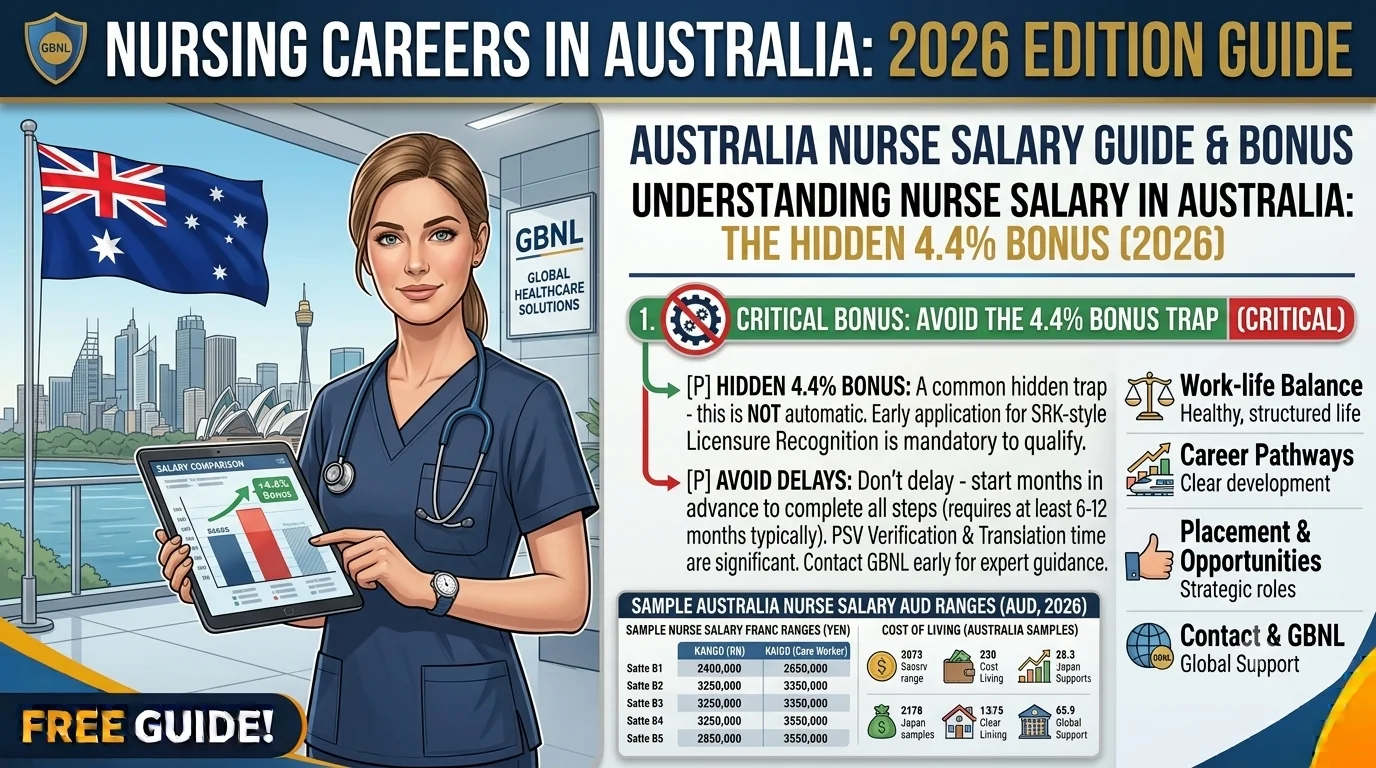
Nurse salary in Australia runs AUD 70,235 to 115,825 or more under award rates, with an average advertised market salary around AUD 82,500. But comparing job offers on gross salary alone misses one of the biggest factors in what a nursing role actually pays: salary packaging, a tax-free benefit that can add the equivalent of a 4.4 percent pay rise that never appears on the number in your contract.
Quick Facts
- Award salary range: AUD 70,235 to 115,825+, average market rate around AUD 82,500
- Nurse practitioners: AUD 110,000 to 155,000+
- Superannuation: an additional 11.5 percent employer contribution on top of gross salary
- Salary packaging (public/NFP sector): up to roughly AUD 9,010 to 11,660 a year tax-free
- Registration body: AHPRA, via the Nursing and Midwifery Board of Australia’s IQNM Self-Check
- Typical registration timeline for internationally trained nurses: 6 to 12 months
Table of Contents
The Number Most Salary Comparisons Miss
Public and not-for-profit hospitals in Australia let eligible nurses “package” a portion of everyday living expenses, things like rent, mortgage payments, and bills, tax-free, up to around AUD 9,010 a year, plus a separate meal and entertainment allowance of roughly AUD 2,650. Combined, that’s close to AUD 11,660 a year that never gets taxed. On a typical mid-career nurse’s marginal tax rate, this works out to an effective annual take-home boost of around AUD 3,700, the equivalent of a 4.4 percent pay rise that simply doesn’t show up anywhere on your gross salary figure.
This is exactly why a private-sector job offering a slightly higher headline salary can end up paying less in real take-home terms than a public-sector role with a lower gross figure. If you’re comparing two offers, ask specifically whether salary packaging is included before assuming the bigger number wins.
Nurse Salary in Australia by Role and Experience
Registered nurses earn AUD 70,235 to 115,825 or more under award rates, with the average advertised market salary sitting around AUD 82,500 and top positions reaching AUD 95,000 to 110,000 or higher. Enrolled nurses earn somewhat less, generally AUD 54,230 to 68,000. ICU nurses commonly earn AUD 85,000 to 110,000, and nurse practitioners, the most senior clinical classification, typically earn AUD 110,000 to 155,000 or more depending on setting and experience.
Locum and temporary nursing pays by the hour rather than salary, generally AUD 45 to 75 an hour depending on specialization, which can work out to AUD 90,000 to 130,000 or more annually for someone working full-time hours.
State and Territory Differences
The Northern Territory, particularly Darwin, offers the highest remote area allowances and salary packaging benefits of any Australian jurisdiction, with effective total remuneration for NT-based nurses often exceeding comparable roles in the eastern states once these benefits are included. The ACT tends to sit at the higher end nationally for base rates, while South Australia and Tasmania run broadly comparable to the eastern states. Regional and remote postings anywhere in the country commonly carry an additional allowance, typically AUD 5,000 to 15,000 a year, on top of standard penalty rates and base pay.
Public vs Private: Which Actually Pays More?
This isn’t as simple as most articles suggest. Public sector nurses generally have higher base salaries under enterprise agreements, along with stronger salary packaging access, higher superannuation contributions in some agreements, and more defined penalty rate entitlements. Private hospitals don’t uniformly pay less, and senior clinical or leadership roles in private hospitals, particularly in metropolitan areas, can offer genuinely competitive base salaries. But private-sector nurses typically have less access to salary packaging and fewer penalty rate entitlements, which is exactly why total effective remuneration in the public sector often outpaces a private role with a similar or even slightly higher headline salary.
What You Need Before Any of These Numbers Apply to You
Registration with AHPRA (the Australian Health Practitioner Regulation Agency), through the Nursing and Midwifery Board of Australia, is mandatory before you can legally practice or earn any of the salaries above. Internationally trained nurses start with the IQNM (Internationally Qualified Nurse and Midwife) Self-Check, which places you into one of three streams:
- Stream A (Substantially Equivalent): your qualification is comparable to an Australian Bachelor of Nursing. This is the fastest pathway, generally requiring only an assessment and orientation step.
- Stream B (Relevant but Not Equivalent): your qualification is relevant but has gaps, generally requiring an Outcome-Based Assessment that can include NCLEX-RN and an OSCE (Objective Structured Clinical Examination).
- Stream C (Not Equivalent): your qualification doesn’t currently meet Australian standards, generally requiring a bridging or transition program of three to twelve months before registration.
Most internationally trained nurses complete this whole process, from IQNM Self-Check to active AHPRA registration, in six to twelve months.
A Recent Update Worth Knowing
Since April 2025, nurses from the UK, USA, Canada, Ireland, and New Zealand, classified as “comparable jurisdictions,” have access to a streamlined, faster AHPRA registration pathway that skips the full Outcome-Based Assessment most other internationally trained nurses go through. If you trained in one of these countries, confirm whether you qualify for this faster route before assuming the standard IQNM stream process applies to you.
Don’t Forget Superannuation
On top of every salary figure above, Australian employers contribute an additional 11.5 percent of your salary into superannuation, Australia’s compulsory retirement savings system. This is genuinely additional to your gross pay, not a deduction from it, and it’s a meaningful long-term wealth-building benefit that nurses relocating from countries without an equivalent system often overlook when comparing Australia against other destinations.
Common Mistakes When Comparing Nursing Salaries in Australia
- Comparing gross salary only. Salary packaging, superannuation, and penalty rates can shift the real value of an offer significantly in either direction.
- Assuming private hospitals automatically pay more. Public sector total remuneration frequently outpaces private roles once salary packaging is included.
- Not checking which IQNM stream applies to you before job hunting. Stream C candidates need a bridging program before registration, which affects your realistic timeline more than your salary expectations.
- Overlooking the comparable jurisdictions fast-track. UK, US, Canadian, Irish, and New Zealand-trained nurses may qualify for a faster registration route introduced in April 2025.
- Ignoring regional and remote allowances. The Northern Territory and other remote postings can meaningfully outperform metro salaries once allowances are included.
Frequently Asked Questions
What is the average nurse salary in Australia?
Around AUD 82,500 for the average advertised registered nurse role, with award rates ranging from AUD 70,235 to 115,825 or more depending on classification and experience.
What is salary packaging, and why does it matter?
Salary packaging lets eligible nurses, mainly in public and not-for-profit hospitals, pay for everyday expenses tax-free up to roughly AUD 9,010 to 11,660 a year, adding an effective 4.4 percent pay rise that doesn’t appear on the gross salary figure.
Do private hospitals pay nurses more than public hospitals in Australia?
Not necessarily. Public sector roles often have stronger total remuneration once salary packaging and superannuation are included, even when the private-sector base salary looks slightly higher.
What is the IQNM Self-Check?
A tool from the Nursing and Midwifery Board of Australia that places internationally trained nurses into one of three streams (A, B, or C) based on how closely their qualification matches an Australian Bachelor of Nursing, determining what additional assessment, if any, is required before AHPRA registration.
How long does AHPRA registration take for internationally trained nurses?
Generally 6 to 12 months from starting the IQNM Self-Check to holding active registration, though Stream C candidates needing a bridging program may take longer.
About the Author
This guide was written by the team at Rahat Health Care Professionals Consultancy & Training Center, led by founder Rahat Zaman, a medical licensing consultant since 2018 with hands-on experience guiding healthcare professionals through DHA, MOH, DOH, and wider Gulf licensing processes. Our team has supported over 21000 healthcare professionals through DataFlow verification, exam registration, and license activation across the UAE and internationally.
Last updated: September 2026
Follow us on social media to stay updated!