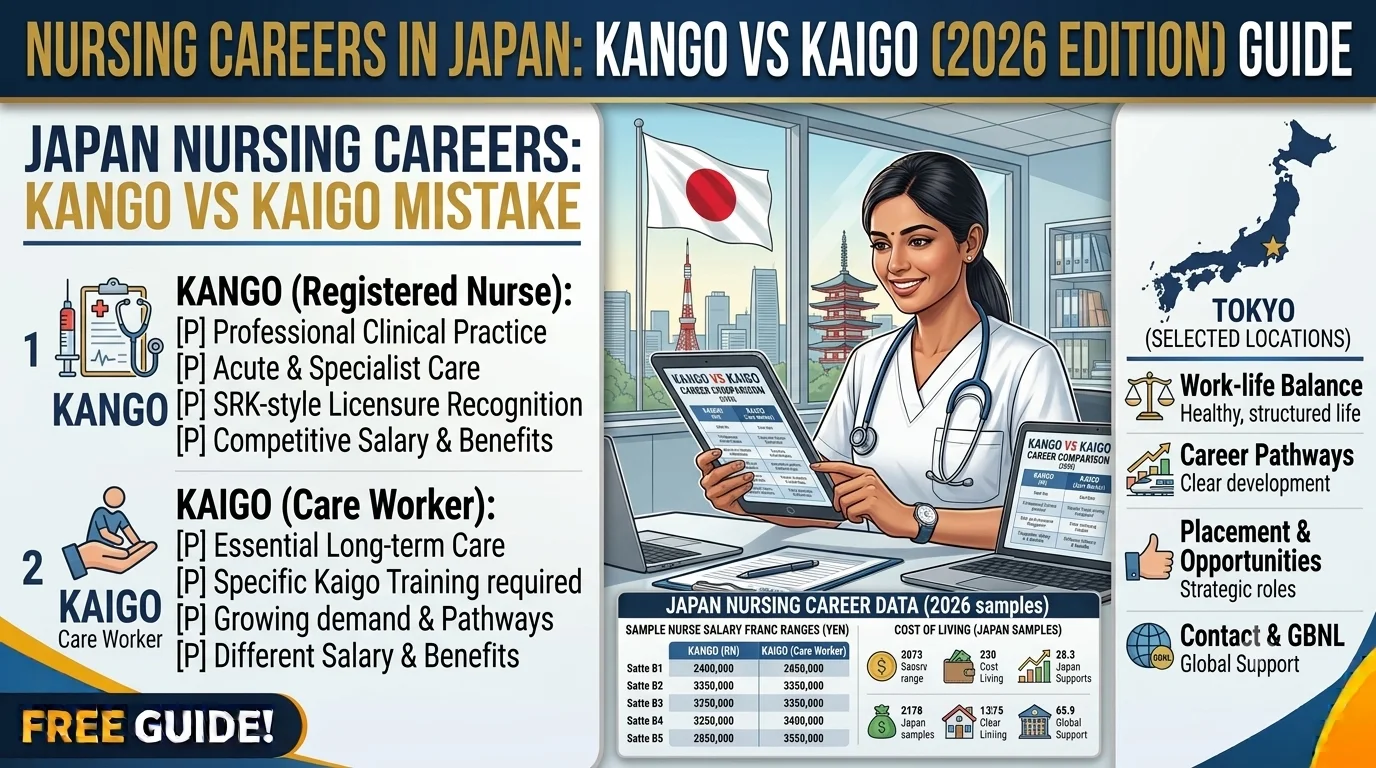
Nursing jobs in Japan are genuinely in demand, but a huge share of what shows up when people search this topic is actually about a completely different profession. Registered nursing (kango-shi) and certified care work (kaigo fukushi-shi) are two separate jobs, with separate exams, separate visas, and separate pay scales, and mixing them up wastes real time. This guide is specifically about registered nursing.
Quick Facts
- Registered nurse title: kango-shi (看護師), a hospital-based clinical role
- Care worker title: kaigo fukushi-shi (介護福祉士), a long-term and elderly care role, not clinical nursing
- Licensing exam: the National Nursing Examination (NNE), required of every applicant regardless of nationality
- Structured entry pathway: EPA (Economic Partnership Agreement), open only to candidates from Indonesia, the Philippines, and Vietnam
- Typical salary: JPY 5 million to 7.5 million a year, with Tokyo roles running 15 to 35 percent above the national average
- Language requirement: functional Japanese is required for both nursing and care work, though the specific proficiency threshold differs by program
The Mistake Almost Everyone Makes: Nurse vs Care Worker
Search “nursing jobs in Japan” and a large share of what comes back is actually about kaigo, certified care work in elderly and long-term care facilities, not clinical nursing in a hospital. They’re both respected, in-demand professions, but they are not the same job, and they don’t share a licensing exam, a visa category, or a pay scale.
A registered nurse (kango-shi) works in hospitals and clinics under a nursing license earned through Japan’s National Nursing Examination. A certified care worker (kaigo fukushi-shi) works in elderly care and long-term care facilities under a separate qualification, earned either through a three-year Japanese care worker training school, a separate national care worker exam, or Japan’s Specified Skilled Worker (SSW) visa route for care. If you’re specifically trained and experienced as a nurse, make sure whatever guide or recruiter you’re talking to is actually discussing the nursing pathway, not the care worker one, since online content blends the two constantly.
Table of Contents
The Registered Nurse Pathway: What It Actually Requires
Every nurse, regardless of nationality, has to pass Japan’s National Nursing Examination (NNE) to become licensed. There’s no shortcut around this exam itself, and it’s administered in Japanese.
What differs by nationality is whether you have a structured, legal pathway to be in Japan while you prepare for it. Under the Economic Partnership Agreement, candidates from Indonesia, the Philippines, and Vietnam can enter Japan through a government-to-government program that includes Japanese-language training, a placement at a receiving hospital, and a multi-year window to prepare for and sit the exam. Indonesian candidates have been accepted since 2008, Filipino candidates since 2009, and Vietnamese candidates since 2014. As of now, no other nationalities have access to this structured EPA nursing pathway.
If you’re not from one of these three countries, there’s no equivalent legal, structured route into Japan specifically to prepare for the nursing exam. You’d need to independently arrange a visa, language study, and exam preparation, which is a meaningfully harder and rarer path than what EPA candidates go through.
The Honest Part: The Exam Is Genuinely Difficult
Even with EPA support, pass rates on the National Nursing Examination for foreign candidates have historically been low, largely because of the exam’s dense medical kanji and technical terminology. Some accommodations have been introduced over the years, including furigana readings for difficult characters and English-language glossaries for some terms, but the underlying exam content and difficulty haven’t been reduced. A meaningful number of EPA nursing candidates who relocate to Japan don’t end up passing within their program window, and attrition throughout the process is a well-documented, real part of this pathway, not a rare exception. Anyone weighing this route seriously should treat the exam as a genuine, multi-year challenge rather than a formality on top of relocating.
Salary for Registered Nurses in Japan
Nurses in Japan typically earn between JPY 5 million and JPY 7.5 million a year, roughly JPY 420,000 to 625,000 a month. Tokyo-based roles generally pay 15 to 35 percent above the national figures, and rural facilities facing acute staffing shortages sometimes offer relocation support or housing incentives on top of base pay to attract nurses willing to work outside major cities.
Why Demand Is So High Right Now
Japan is facing one of the most severe nursing shortages of any developed healthcare system, with job-to-applicant ratios exceeding 3:1 in many regions. An aging population combined with a domestic nursing workforce that isn’t growing fast enough to match demand is driving both the shortage and the wage growth behind it, particularly in regions actively trying to attract staff with better pay and incentives.
Language Reality: It’s Not the Same Requirement Everywhere
Language expectations differ depending on the specific program and role, which adds to the general confusion around this topic. Some EPA arrangements have historically required a baseline as low as JLPT N5 on arrival for certain care worker candidates, while others, such as the EPA agreement with Vietnam, required a stronger N3-level baseline before candidates even arrived. Passing the National Nursing Examination itself, regardless of your starting level, ultimately requires strong functional Japanese, since the exam is conducted in Japanese and clinical documentation and patient communication in Japanese hospitals run in Japanese as well.
Frequently Asked Questions
Is a nursing job in Japan the same as a care worker job?
No. Registered nursing (kango-shi) and certified care work (kaigo fukushi-shi) are separate professions with separate exams, visas, and pay scales. A large share of “nursing jobs in Japan” search results are actually about care work.
Can nurses from any country apply through the EPA pathway?
No. The EPA nursing pathway is open only to candidates from Indonesia, the Philippines, and Vietnam. Nurses from other countries don’t have an equivalent structured, government-to-government route into Japan.
Do I still need to pass Japan’s National Nursing Examination if I enter through EPA?
Yes. EPA provides language training, a hospital placement, and a legal pathway to prepare in Japan, but it doesn’t reduce or waive the exam itself, which every nurse must pass regardless of nationality.
How much do nurses earn in Japan?
Generally JPY 5 million to 7.5 million a year, with Tokyo roles running 15 to 35 percent above the national average.
Is the National Nursing Examination hard for foreign candidates to pass?
Yes. Pass rates for foreign candidates have historically been low, mainly due to dense medical kanji and technical Japanese terminology, and a meaningful share of EPA candidates don’t pass within their program’s window despite structured support.
About the Author
This guide was written by the team at Rahat Health Care Professionals Consultancy & Training Center, led by founder Rahat Zaman, a medical licensing consultant since 2018 with hands-on experience guiding healthcare professionals through DHA, MOH, DOH, and wider Gulf licensing processes. Our team has supported over 21000 healthcare professionals through DataFlow verification, exam registration, and license activation across the UAE and internationally.
Last updated: July 2026
Follow us on social media to stay updated!