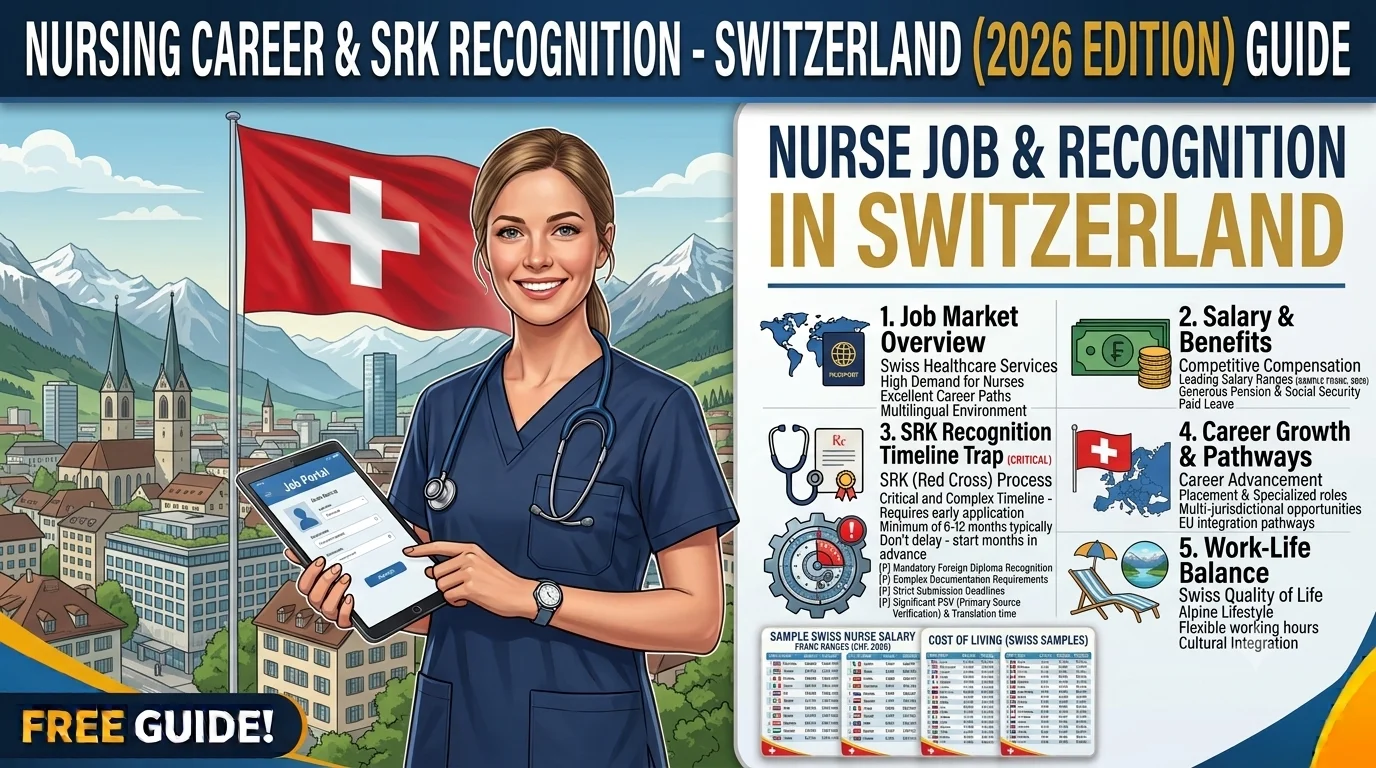
Nursing jobs in Switzerland offer some of the highest pay in the world for the profession, but almost every article covering this topic glosses over one detail that changes everything about your timeline: whether you’re an EU/EFTA citizen or not. Here’s the quick version, then the full breakdown.
Quick Facts
- Recognition authority: Swiss Red Cross (SRK/CRS), not MEBEKO, which only handles doctors, dentists, and pharmacists
- Timeline for EU/EFTA nurses: 4 to 8 weeks, generally free of charge
- Timeline for non-EU nurses: 4 to 9 months, sometimes longer if an adaptation module or aptitude test is required
- Typical salary: CHF 75,000 to 92,000 gross per year, rising to around CHF 110,000 for senior base roles
- Language requirement: B1 to B2 in German, French, or Italian, depending on the canton
- Work permit: Free movement for EU/EFTA citizens; a B-permit or cross-border G-permit for others
Why the SRK Timeline Catches So Many Applicants Off Guard
Most nursing jobs in Switzerland require your foreign nursing diploma to be formally recognized by the Swiss Red Cross before you can practice, since nursing is a regulated profession there. The problem is that most guides quote a single timeline, usually the fast one, without making clear that it only applies to EU/EFTA-trained nurses.
If your degree comes from an EU or EFTA country, SRK recognition typically takes 4 to 8 weeks for a complete application, and it’s generally free. If you trained outside the EU/EFTA zone, expect 4 to 9 months instead, and if your curriculum doesn’t align closely enough with the Swiss HF bachelor standard, SRK can require an adaptation module lasting 3 to 12 months, or an aptitude test, on top of that. This is the single biggest reason non-EU applicants underestimate how long moving to Switzerland actually takes.
Table of Contents
What Nursing Jobs in Switzerland Actually Look Like
Demand is genuinely strong, particularly in German-speaking cantons and Vaud, where structural nursing shortages have led several regions to introduce accelerated pathways specifically for ICU, care home, and paediatric roles. Zurich, Geneva, and Bern remain the largest employment hubs, though rural and specialized facilities in other cantons often recruit just as actively, sometimes with faster processing support for candidates in high-need specialties.
Nurse Salary in Switzerland: What You Actually Take Home
Base pay for a newly qualified nurse generally starts around CHF 75,000 to 82,000 gross per year under standard collective labor agreements, rising to CHF 85,000 to 92,000 after around five years, and up to CHF 110,000 for senior base-role nurses by the end of a career. Specializations such as ICU, anesthesia, operating room, and emergency care typically add another 5 to 15 percent on top of these figures.
Switzerland’s cost of living is genuinely high, particularly in Zurich and Geneva, but salaries scale accordingly, and nurses commonly report meaningful savings even after rent, health insurance, and taxes, especially outside the most expensive city centers.
Language Requirements Depend Entirely on the Canton
Switzerland doesn’t have one national language, and neither does its nursing workforce. German-speaking cantons generally expect B2-level German for clinical roles. French-speaking cantons such as Geneva and Vaud expect a comparable level of French, and Italian-speaking Ticino expects Italian. Some hospitals in Geneva or Zurich occasionally accept a slightly lower starting level with a commitment to improve on the job, but this is the exception rather than the rule, so confirm the actual expectation with your target employer rather than assuming a lower bar applies everywhere.
Work Permits: EU/EFTA vs Everyone Else
EU/EFTA citizens benefit from free movement agreements, which meaningfully simplifies both the work permit and, in most cases, the SRK recognition timeline. Non-EU/EFTA applicants generally need an employer-sponsored B-permit to reside and work in Switzerland long-term. A separate G-permit exists for cross-border commuters, most relevant to nurses living in a neighboring country such as France, Germany, or Italy and commuting to a Swiss workplace, which comes with its own tax treatment that differs meaningfully from full Swiss residency.
Documents You’ll Typically Need
- Original nursing diploma with a certified translation from a sworn translator
- Complete academic transcripts showing both theoretical and clinical training hours
- Employment certificates proving at least one year of post-graduation professional practice
- A valid identity document or passport
- Proof of current professional registration in your home country (required specifically for non-EU applicants)
- Language proficiency certification matching your target canton’s requirement
Common Mistakes That Slow Down Nursing Jobs in Switzerland Applications
- Assuming the fast EU/EFTA timeline applies to everyone. Non-EU applicants routinely underestimate their own timeline by several months.
- Submitting an incomplete SRK application. Missing documents or uncertified translations extend processing significantly beyond the standard timeline.
- Not checking canton-specific language requirements before applying. A B2 German certificate doesn’t help you in Geneva or Ticino.
- Underestimating the adaptation module possibility. If your curriculum doesn’t map closely to the Swiss HF bachelor, budget for an additional 3 to 12 months rather than assuming automatic recognition.
- Choosing a G-permit or B-permit without comparing the tax and long-term implications. For nurses planning to stay more than a few years, a B-permit is often more tax-efficient at the same gross salary.
Frequently Asked Questions
How long does SRK recognition actually take? 4 to 8 weeks for EU/EFTA-trained nurses with a complete application, but 4 to 9 months for non-EU nurses, sometimes longer if an adaptation module or aptitude test is required.
How much do nurses actually earn in Switzerland? Generally CHF 75,000 to 92,000 gross per year depending on experience, with senior base-role nurses reaching around CHF 110,000, and specialty roles like ICU or anesthesia adding 5 to 15 percent more.
Do I need to speak German to work as a nurse in Switzerland? Only if you’re applying in a German-speaking canton. French-speaking cantons expect French, and Ticino expects Italian, generally at B1 to B2 level.
What’s the difference between a B-permit and a G-permit? A B-permit is for Swiss residents and generally offers stronger long-term tax efficiency, while a G-permit is for cross-border commuters living in a neighboring country and comes with a different tax treatment.
Does the Swiss Red Cross handle recognition for all healthcare professions? No. SRK handles nursing and midwifery recognition specifically. Doctors, dentists, and pharmacists go through MEBEKO instead.
About the Author
This guide was written by the team at Rahat Health Care Professionals Consultancy & Training Center, led by founder Rahat Zaman, a medical licensing consultant since 2018 with hands-on experience guiding healthcare professionals through DHA, MOH, DOH, and wider Gulf licensing processes. Our team has supported over 21000 healthcare professionals through DataFlow verification, exam registration, and license activation across the UAE and internationally.
Last updated: July 2026
Follow us on social media to stay updated!