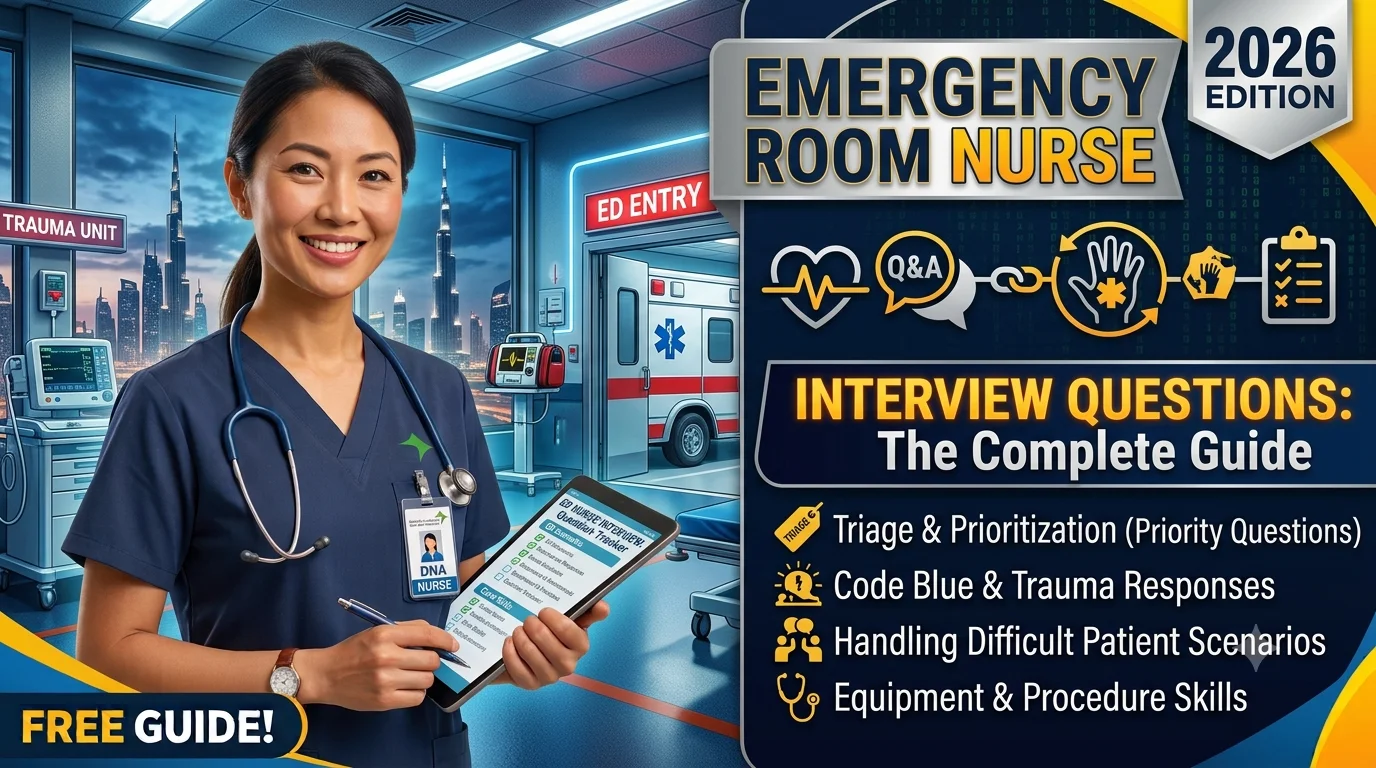
An emergency room nurse interview is built around one core question the panel is really trying to answer: can you think clearly, act fast, and stay compassionate when everything is happening at once. Below is a complete set of the questions you are most likely to face for an ER, ED, or Emergency RN position, whether the posting is titled emergency room nurse, ED nurse, or emergency department nursing, organized by category, with guidance on what each question is actually testing and how to structure a strong answer. Why ER and ED Nurse Interviews Are Different Emergency department interviews test something general ward interviews do not: your ability to make sound clinical decisions with incomplete information, under time pressure, without the luxury of a stable, predictable patient load. A medical-surgical or general ward interview often focuses on routine care planning and steady patient relationships built over days. An emergency room interview focuses on the opposite: rapid assessment, triage judgment, split second prioritization, and the emotional resilience to move from a cardiac arrest to a panicked parent in the space of ten minutes. Interviewers in the ED space are listening for specific evidence of this, not general nursing competence. That is why the same generic answer that works for a med-surg interview often falls flat here. Every answer below is built around demonstrating clinical judgment under pressure, not just describing that you have experience. Why ER and ED Nurse Interviews Are DifferentBehavioral and Experience-Based QuestionsClinical and Scenario-Based QuestionsTeamwork and Communication QuestionsStress Management and Resilience QuestionsQuestions You Should Ask the InterviewerHow to Prepare for Your ER Nurse Interview: A 5-Step FrameworkPediatric and Special Population QuestionsDocumentation and Legal Awareness QuestionsCommon Mistakes Candidates Make in ED InterviewsFrequently Asked QuestionsWhat is the most common emergency room nurse interview question?How is an ED nurse interview different from a general nursing interview?Should I use the STAR method for emergency nursing interview answers?What should I ask the interviewer during an ER nurse interview?Do I need my nursing license finalized before interviewing for an ER position?How should I answer a question about handling patient deterioration when the physician is unavailable?Final Thoughts Behavioral and Experience-Based Questions These questions look backward at your actual work history to predict how you will perform under similar conditions in a new department. "Walk me through a shift where everything seemed to go wrong at once." This question is testing composure and prioritization, not whether your shift was actually chaotic. Structure your answer around a specific example: what competing demands you faced, how you decided what came first, and what the outcome was. Avoid vague answers like "it was really busy." Interviewers want the decision-making process, not just the description of stress. "Tell me about a time you had to advocate for a patient against pushback from a colleague or physician." This tests both clinical confidence and professionalism under conflict. A strong answer shows you raised a concern respectfully, backed it with clinical reasoning or objective data (vital signs, lab values, patient presentation), and followed the appropriate escalation channel if you were not immediately heard. "Describe the most challenging patient interaction you have had and how you handled it." Interviewers are checking for emotional regulation and de-escalation skill here, not just empathy. Describe the specific behavior or situation, what you did to de-escalate or manage it, and what you would do differently, if anything, with hindsight. "Why did you choose emergency nursing specifically, rather than another specialty?" This is a motivation and fit question. Vague answers like "I like the fast pace" are common and forgettable. A stronger answer connects a specific experience, a rotation, a mentor, a particular case, to why the unpredictability and acuity of ED work genuinely suits how you think and work. "What has been your proudest moment as an ER nurse?" Interviewers use this to gauge what you personally value in the role. Whether your example centers on a clinical save, a difficult family you supported well, or a process improvement you contributed to, tie it back to the qualities the department actually needs. Clinical and Scenario-Based Questions These are the questions that carry the most weight in an ED interview, since they test real time clinical reasoning rather than rehearsed answers. "A patient presents with chest pain and shortness of breath. Walk me through your immediate priorities." The interviewer wants your assessment sequence: airway, breathing, circulation, obtaining vitals and an ECG promptly, escalating to the physician, and beginning appropriate monitoring, all while explaining your clinical reasoning out loud rather than jumping straight to a diagnosis. "How do you triage when three patients arrive simultaneously, all appearing urgent?" This tests your understanding of triage systems (such as ESI or a similar acuity scale) and your ability to apply them under pressure rather than triage based on who is loudest or most visibly distressed. "A patient's condition is deteriorating, but the assigned physician is currently tied up with another emergency. What do you do?" This tests escalation judgment. A strong answer describes initiating appropriate immediate interventions within your scope, notifying the charge nurse or a second physician, and continuing close monitoring rather than waiting passively. "How would you handle a mass casualty or sudden surge in patient volume?" Interviewers want evidence you understand surge protocols, can rapidly re-triage, and can function within a team based response rather than trying to manage everything individually. "A family member is distressed and interfering with your ability to treat the patient. How do you handle it?" This tests communication under pressure. A good answer separates immediate patient safety (calmly but firmly creating space to work) from longer term family communication (updating them clearly once the patient is stabilized, rather than shutting them out entirely). "You suspect a medication error may have occurred, either yours or a colleague's. What is your next step?" This tests integrity and safety culture. The expected answer involves immediate patient assessment, transparent reporting through the correct incident channel, and following facility protocol rather than covering up or minimizing the issue. "How do you approach a patient who is intoxicated, aggressive, or difficult to assess accurately?" This tests both safety awareness and clinical judgment, since intoxication can mask or mimic serious underlying conditions. Strong answers describe maintaining personal and team safety while still ruling out dangerous causes rather than assuming behavior is purely related to substance use. Teamwork and Communication Questions Emergency departments run on rapid, high-stakes team coordination, and interviewers specifically probe for this. "Describe a time you disagreed with a physician's treatment plan. What did you do?" This tests whether you can advocate professionally without becoming confrontational or, at the other extreme, staying silent when something feels wrong. "How do you communicate effectively during a handoff between shifts in a chaotic environment?" Interviewers are checking whether you understand structured handoff tools (such as SBAR) and can communicate critical information concisely, even when time is short. "Tell me about a time a team member was struggling, and how you supported them." This checks for collegial awareness in a high burnout specialty. Strong answers show you noticed a colleague struggling and stepped in constructively, rather than focusing purely on your own workload. Stress Management and Resilience Questions Retention in emergency nursing depends heavily on how well a candidate manages the psychological demands of the role, which is why interviewers ask about this directly. "How do you decompress after a particularly difficult shift, especially one involving a patient death or trauma?" Interviewers want evidence of a genuine, sustainable coping strategy, whether that is peer debriefing, a personal routine, or utilizing employee support resources, rather than a vague "I just move on" answer. "How do you avoid burnout in a high acuity environment like the ED?" This tests self-awareness and long term sustainability. Mentioning specific habits, boundaries around overtime, physical activity, structured debriefing, tends to land better than a generic statement about resilience. Questions You Should Ask the Interviewer A strong ED candidate also comes prepared with specific questions, since this signals genuine interest in how the department actually functions day to day. Consider asking about the nurse to patient ratio during peak hours, how the department handles surge capacity, what the orientation and preceptorship period looks like for new ED hires, and how the team typically debriefs after a critical or traumatic case. These questions demonstrate that you are evaluating fit seriously, not just hoping to receive an offer, and they often prompt the interviewer to share details about department culture that a candidate would otherwise never learn until after starting the job. How to Prepare for Your ER Nurse Interview: A 5-Step Framework Step 1: Review your own case history for strong examples. Before the interview, mentally walk through two or three genuinely challenging shifts or cases you can speak to in detail, covering clinical decision-making, communication, and outcome. Step 2: Practice structuring answers using the STAR method. Situation, Task, Action, Result. This keeps clinical scenario answers concrete rather than vague, and it is exactly the structure most interviewers are listening for even when they do not say so directly. Step 3: Refresh your knowledge of triage frameworks and common ED protocols. Even experienced nurses benefit from a quick review of acuity scoring systems and your target facility's general approach to surge and escalation, since interviewers often reference this directly. Step 4: Prepare two or three thoughtful questions of your own. Use the list above as a starting point, tailored to what you actually want to know about the specific department. Step 5: If you are also completing or renewing a nursing license as part of this move, confirm that timeline separately. Many ED nurses interview for a position while their license or DataFlow verification is still processing, and being able to speak clearly about your licensing timeline reassures a hiring manager that you are organized and close to ready. Pediatric and Special Population Questions Many ED interviews include at least one question specific to vulnerable populations, since pediatric, elderly, and pregnant patients require adjusted clinical reasoning. "How does your assessment approach change with a pediatric patient compared to an adult in the ED?" This tests whether you understand that vital sign ranges, communication style, and even pain assessment differ meaningfully in children. Strong answers reference age appropriate assessment tools and the importance of involving caregivers in both history taking and reassurance. "An elderly patient presents with confusion. How do you determine whether this is baseline or acute?" Interviewers want to see that you consider collateral history from family or caregivers, rule out reversible causes such as infection or medication interaction, and avoid assuming confusion is simply age related. "How do you approach pain assessment in a patient who cannot clearly communicate their pain level?" This tests your familiarity with observational pain scales and your willingness to treat based on clinical presentation rather than requiring verbal confirmation alone. Documentation and Legal Awareness Questions Fast paced environments do not excuse incomplete documentation, and interviewers often probe this directly. "How do you keep documentation accurate and complete during an extremely busy shift?" Strong answers describe real time or near real time charting habits, rather than relying on memory to backfill notes hours later, along with an understanding of why timely documentation matters both clinically and legally. "What would you do if you realized after the fact that you had charted something incorrectly?" This tests integrity and knowledge of correction procedures. The expected answer involves following your facility's formal amendment process rather than deleting or altering the original entry. Common Mistakes Candidates Make in ED Interviews A few patterns show up repeatedly in weaker ED interview performances, and avoiding them is often as valuable as preparing strong answers. Answering clinical scenarios too generically. Saying "I would assess the patient and call the doctor if needed" without walking through your actual assessment sequence gives the interviewer nothing to evaluate. Specificity is what demonstrates real clinical reasoning. Downplaying the emotional intensity of the role. Candidates sometimes avoid discussing difficult cases, patient deaths, or burnout out of concern it will look negative. Interviewers generally read the opposite way. Acknowledging the difficulty and describing how you manage it well shows maturity, not weakness. Not preparing questions of their own. Arriving without questions can read as a lack of genuine interest in how the department actually operates, even if that is not the intended impression. Failing to mention teamwork explicitly. Since ED care is inherently team based, candidates who describe every scenario as a solo effort often raise a quiet concern about collaboration, even when their individual clinical judgment is strong. Frequently Asked Questions What is the most common emergency room nurse interview question?Scenario based clinical questions, such as how you would triage multiple urgent patients arriving at once, are among the most consistently asked, since they reveal real time clinical reasoning better than behavioral questions alone.How is an ED nurse interview different from a general nursing interview?ED interviews focus heavily on rapid assessment, triage judgment, and composure under unpredictable, high acuity conditions, rather than the steady care planning emphasized in general ward interviews.Should I use the STAR method for emergency nursing interview answers?Yes. Structuring your answers around Situation, Task, Action, and Result keeps clinical examples concrete and gives interviewers exactly the detail they are listening for.What should I ask the interviewer during an ER nurse interview?Strong questions include the department's nurse to patient ratio during peak hours, how the team handles surge capacity, and what orientation looks like for new ED hires.Do I need my nursing license finalized before interviewing for an ER position?Not always. Many ED nurses interview while their licensing or DataFlow verification is still in progress, provided they can speak clearly and confidently about their expected timeline.How should I answer a question about handling patient deterioration when the physician is unavailable?Describe initiating appropriate interventions within your scope, escalating to a charge nurse or second available physician, and maintaining close monitoring, showing that you act rather than wait passively. Final Thoughts Emergency room nurse interviews reward candidates who can show clear thinking under pressure, not just recite clinical knowledge. Prepare specific examples, practice structuring them clearly, and go in ready to discuss both your clinical judgment and how you personally manage the intensity of ED work. If you are interviewing for a position in the UAE or the wider Gulf and still need to complete your licensing exam or DataFlow verification, see our complete DHA exam guide and our DHA exam guide for nurses to make sure your paperwork is not the thing standing between you and your next offer. For guidance tailored to your specific situation, get in touch with our team, or explore our nursing exam preparation courses. For general, employer facing perspectives on ER nurse hiring, resources like Indeed's career advice section are also worth reviewing alongside this guide. About the Author This guide was written by the team at Rahat Health Care Professionals Consultancy & Training Center, led by founder Rahat Zaman, a medical licensing consultant since 2018 with hands-on experience guiding healthcare professionals through DHA, MOH, DOH, and wider Gulf licensing processes. Our team has supported over 21,000 healthcare professionals through DataFlow verification, exam registration, and license activation across the UAE and internationally. Last updated: July 2026 Follow us on social media.